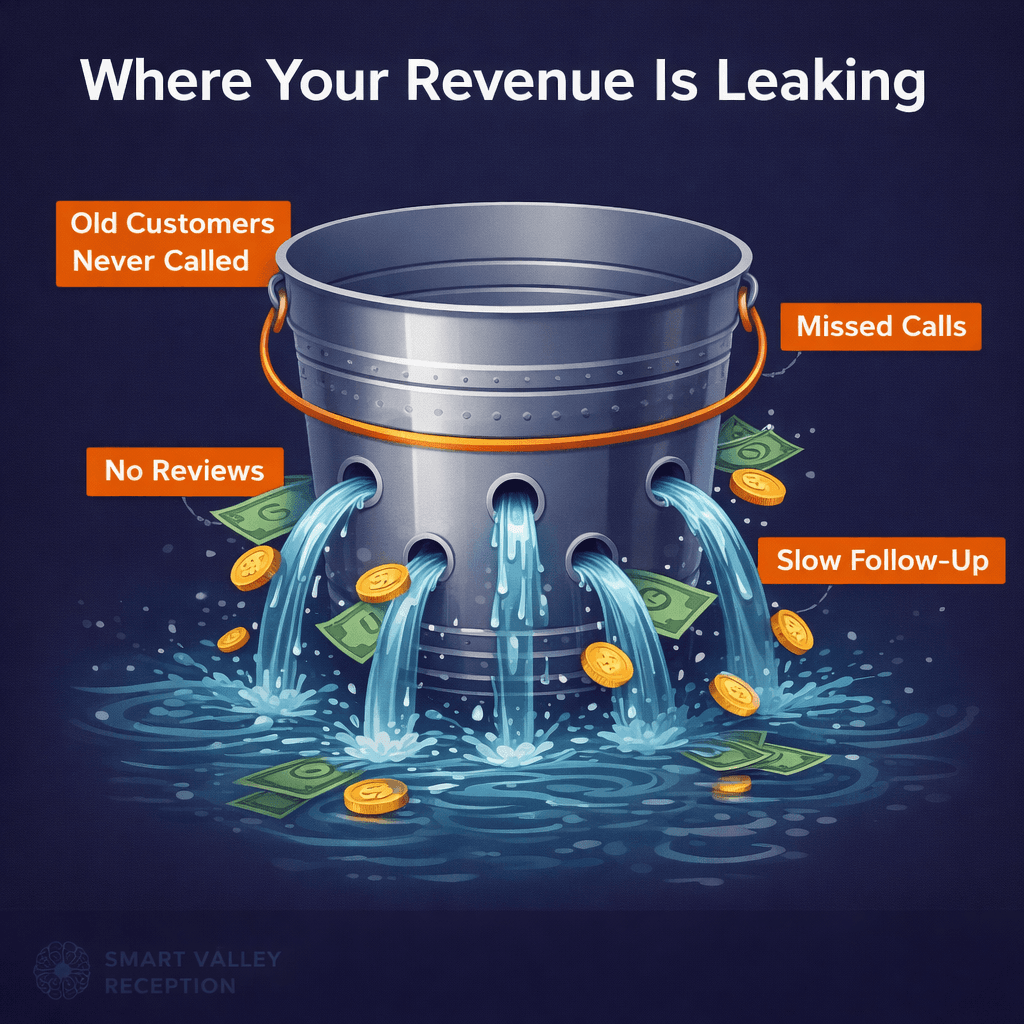

It is 2:47 PM on a Tuesday in July, your tech is under a crawlspace in Scottsdale, your other line is ringing, and a new caller just hit voicemail because nobody picked up. That caller, statistically, will not leave a message. They will call the next HVAC company on the list. For Phoenix HVAC businesses, this scenario plays out dozens of times a week, quietly costing thousands in lost revenue without ever appearing on a report. This article breaks down exactly why the missed call problem is worse than most owners realize, why a traditional receptionist hire rarely fixes it, and how a growing number of Phoenix HVAC companies are using AI receptionists to capture every call, qualify leads, and book jobs around the clock without adding payroll.
The Phoenix HVAC Call Problem Nobody Talks About

Picture this: it's 2pm on a Tuesday in July. You're three stories up on a Scottsdale rooftop, the surface temperature is close to 160 degrees, and you're elbow-deep in a condenser unit that stopped cooling overnight. Your phone has rung six times in the last hour. You haven't answered once.
This is not a story about a bad business owner. It's a story about physics.
During Phoenix peak season, industry data shows that 35 to 50 percent of HVAC calls go unanswered. For a two- or three-truck operation, that number is even harder to fight. Every tech on the crew is running back-to-back jobs. Nobody is sitting at a desk.
The real problem isn't motivation or hustle. It's that answering calls and performing installs are mutually exclusive activities. And in the hottest major metro in the country, the calls don't stop coming just because you're busy. They go to whoever picks up next.
Why Hiring a Receptionist Doesn't Actually Solve It
The first instinct for most HVAC owners facing this problem is to hire someone to answer the phone. It makes sense on paper. In practice, it solves about half the problem and creates a few new ones.
A full-time receptionist in the Phoenix metro runs $3,000 to $3,500 per month once you factor in salary, payroll taxes, and benefits. That person works roughly 9 to 5, Monday through Friday. They call in sick. They take vacation the same week your busiest stretch hits. And when three calls come in simultaneously during a Friday afternoon heat emergency, they can still only handle one at a time.
The deeper issue is structural. HVAC customers don't keep business hours. A homeowner whose AC dies at 9pm on a Sunday isn't waiting until Monday morning to call. The trade demands round-the-clock availability, but paying a human to provide that economically doesn't work for a two- or three-truck operation.
Then there's the seasonality math. Phoenix summers compress the real surge into roughly 90 days. Call volume can triple during that window. Hiring a full-time employee to cover a three-month spike, then carrying that overhead through the slow season, isn't a business decision, it's a cash flow problem waiting to happen.
So the question isn't whether a receptionist is a good employee. The question is whether a salaried, single-line, daytime-only hire was ever the right tool for this specific job. What if you could have 24/7 coverage without a salary, benefits, or sick days?
What an AI Receptionist for HVAC Actually Does

Here is what actually happens when an AI receptionist for HVAC Phoenix operators picks up a call.
Your existing phone number stays exactly where it is. You forward calls to the AI service when you're unavailable, or you can route all inbound calls through it from the start. Either way, callers dial your number. They hear a natural-sounding voice, not a phone tree, not hold music, not voicemail.
From there, the AI works through a real qualification conversation. It asks what's going on: is the AC not cooling, is the unit making noise, is there no airflow at all? It listens for urgency signals. A caller saying "it's 108 outside and my house is at 90 degrees" gets treated differently than someone requesting a fall tune-up. Based on what you've configured, the AI either books a next-available appointment directly into Google Calendar or Cal.com, or it escalates the call to a human for emergency dispatch.
Before the call ends, it captures the caller's name, service address, and a structured summary of the issue. Within seconds of hanging up, the caller receives an SMS confirmation with their booking details or a link to finalize scheduling. That speed matters more than most owners realize, and the numbers in the next section make it concrete.
What the AI does not do is equally important to understand. It doesn't invent answers. Every response it gives is grounded in a knowledge base you configure with your actual service area, hours, pricing ranges, and policies. It doesn't handle every situation, and it's not designed to. For complex jobs, upset callers, or anything outside its defined scope, it transfers to a human. That handoff can be cold, warm, or a whisper transfer where the AI briefs you before connecting.
This is how an AI receptionist service for trade businesses works in practice: precise, configurable, and transparent about its own limits. You can find answers to common setup questions in our frequently asked questions about how it works.
The Numbers: What Missed Calls Actually Cost a Phoenix HVAC Business

That previous section described what the AI does on a single call. This section is about what happens across an entire summer when those calls go unanswered.
The data is not abstract. In Phoenix, a three-truck HVAC operator named Tommy had 847 inbound calls in a single peak-season week. He missed 312 of them, because he was doing exactly what the first section described: running jobs. Those 312 unanswered calls represented roughly $93,600 in potential revenue that went to whoever picked up next. In a separate case study circulated on LinkedIn, an HVAC business attributed $178,000 in added seasonal revenue directly to fixing their missed-call problem. Same trade, same market pressure, radically different outcome.
For a smaller operation, the math is still damaging. Phoenix HVAC service calls average $300 to $500 depending on the job type. If a two-truck company misses just 10 calls per week during the June through August surge, that is 130 missed opportunities over 13 weeks. At a conservative $400 average, that is $52,000 in revenue that never made it onto the schedule. That number does not include the referrals those customers would have generated, or the maintenance contracts they would have signed.
Speed compounds the problem. Research shows that 37 percent of callers who received an automated text after a missed call responded within 90 seconds. These callers have not given up. They just need someone, or something, to respond before a competitor does.
So what does it cost to close that gap? For most small HVAC operators, an AI receptionist subscription runs between $100 and $300 per month, depending on call volume and features. That is a single line item, with no payroll taxes, no benefits, and no sick days. At the low end, it pays for itself if it captures one additional service call per month.
How Phoenix HVAC Owners Are Using AI Receptionists Right Now
The numbers from the previous section describe the problem at scale. What follows is what the solution actually looks like on a Tuesday in July, or a Sunday night in August, or a slow Wednesday in October.
Scenario one: the 9pm emergency call. A homeowner in Paradise Valley notices their upstairs unit has stopped cooling. The indoor temp is climbing. It is 9:47pm, well outside any receptionist's shift. They call the HVAC company they used last year. The AI answers immediately, asks what is happening, and hears that there is no cool air and the house is already at 84 degrees. The AI recognizes the urgency, checks the calendar for the next available morning slot, books it, and sends an SMS confirmation within seconds. If the owner has configured emergency dispatch for after-hours situations, the AI transfers the call with a warm handoff instead. Either way, the caller has an answer before they open a second browser tab to find a competitor.
Scenario two: Monday morning call overflow. It is 8:15am in July. The owner is already en route to a Scottsdale job site. Three calls come in within six minutes. Without AI, two of those callers hit voicemail and move on. With call forwarding active, each call is answered in sequence, qualified, and either booked or routed appropriately. No caller waits. No lead is lost to a competitor who simply picked up.
Scenario three: shoulder season growth without overhead. In October, call volume drops but quote requests and maintenance check-ins pick up. This is the window where HVAC owners want to fill the schedule, but adding staff for a slower period makes no financial sense. An AI answering service for trade businesses handles every inbound inquiry, captures job details, and books tune-ups automatically, without adding a single line to payroll.
Scottsdale and Paradise Valley clients, in particular, expect a professional response the first time they call. An AI that answers instantly, speaks naturally, and confirms a booking before they hang up meets that expectation without requiring anyone to be at a desk.
What to Look for in an AI Receptionist for Your HVAC Business
Those three scenarios from the previous section share a common thread: the AI worked because it was configured to handle the specific situations a Phoenix HVAC business actually faces. That is the right lens for evaluating any service in this category. Not feature count, not marketing copy, but whether it can do the specific things your business needs on its worst days.
Here are the five criteria worth applying.
Emergency escalation logic. This is the non-negotiable for HVAC work. A caller saying "my AC is out and my grandmother is here" is not the same as someone requesting a fall tune-up, and the AI needs to know the difference. Look for a service that lets you define urgency triggers based on specific phrases or conditions, and route those calls differently, whether that means immediate human transfer or same-day priority booking.
Calendar integration that matches what you already use. If your crew runs on Google Calendar, the AI should book directly into it without a workaround. Friction in the booking step means appointments don't actually get confirmed, which defeats the purpose.
Configurable knowledge base. The AI should sound like your company, not a generic HVAC business. That means your service area (Phoenix, Scottsdale, Tempe, Chandler), your hours, your pricing ranges, and your emergency policy. If you can't provide that context, the AI will give callers vague answers that erode trust.
Immediate SMS follow-up. As noted earlier, 37 percent of callers respond to an automated text within 90 seconds. A confirmation message sent before the caller puts their phone down is a meaningful conversion tool, not a nice-to-have.
A free trial before you commit. Setup should be fast, but you still want to test real calls before relying on the system during a July surge. Smart Valley Reception offers a seven-day free trial for qualifying Phoenix and Scottsdale trade businesses, with a branded AI voice agent configured specifically for your operation. That window is enough to run live calls, check the calendar integration, and hear exactly how it handles an emergency escalation scenario before the summer heat hits.
Getting Started: How to Set Up AI Call Coverage for Your HVAC Company

The free trial question from the previous section often leads to the same follow-up: how complicated is this to actually set up? The honest answer is that most Phoenix HVAC operators are live within a single business day. Here is the sequence.
Forward your existing number. No new phone line required. You configure call forwarding from your current business number to your assigned AI service number, either for all calls or only when you don't pick up within a set number of rings. Callers always dial the number they already have for you.
Build out the knowledge base. This is where you give the AI the information it needs to sound like your company. Service area (Phoenix, Scottsdale, Tempe, Chandler, wherever you run crews), hours, service types, pricing ranges, and your emergency policy. The AI won't guess. It works from what you provide, which is exactly what keeps it accurate.
Connect your calendar. Google Calendar and Cal.com integrations handle automatic booking without any manual step on your end. A job gets confirmed before you even know the call came in.
Set your transfer rules. Define the situations where a human needs to take over, such as a caller who is escalating emotionally or a job scope that falls outside your normal service types. The AI hands off cleanly when those triggers appear.
Run test calls before going live. Call it yourself. Try a routine quote request, then try an after-hours emergency scenario. Adjust the knowledge base or escalation logic based on what you hear.
On the question of whether the AI sounds robotic: modern branded voice agents are configured with a name, a tone, and a conversational style that fits your business. Callers rarely identify them as automated on the first exchange. And to answer the question directly, yes, there is an AI receptionist service for trade businesses built for exactly this market. Phoenix HVAC operators are already running their call coverage this way. You can find answers to common setup questions in our frequently asked questions about how it works, or start with the seven-day free trial to test it on real calls before the summer surge arrives.
Efficiently managing calls is the foundation of growth for any Phoenix HVAC company, allowing you to secure more bookings without the overhead of additional staff. By streamlining your scheduling and answering processes, you keep your focus on the job site where it belongs. If you want expert help managing your communication needs, we invite you to view our Services as a natural next step. Our team is here to support your business so you can provide excellent service to your customers every day.